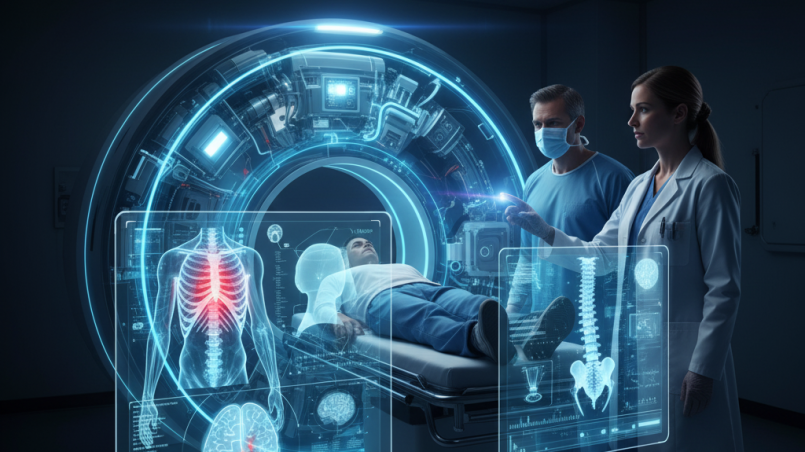
In the fast-paced world of emergency medicine, trauma imaging plays a critical role in rapidly diagnosing injuries and guiding life-saving interventions. Over the past decade, significant advancements in imaging technologies have transformed how trauma patients are assessed and treated.
⚡ 1. Rapid Whole-Body CT Scanning (Pan-Scan)
One of the most impactful innovations is the “pan-scan” approach—whole-body computed tomography (CT) performed immediately after patient arrival. With modern multi-slice CT scanners, clinicians can now assess head, neck, chest, abdomen, pelvis, and spine within minutes. Studies show that early pan-scanning reduces mortality, especially in polytrauma cases.
🧠 2. Advanced Neuroimaging
In head trauma, MRI and CT perfusion imaging now allow more detailed assessment of brain injuries beyond just bleeding. Techniques like Diffusion Tensor Imaging (DTI) help visualize white matter damage, while automated AI tools assist in early detection of subtle hemorrhages or contusions.
🤖 3. Artificial Intelligence (AI) and Machine Learning
AI-driven image analysis is revolutionizing trauma imaging by:
- Detecting fractures, bleeds, and pneumothorax in real-time
- Prioritizing critical scans for radiologist review
- Reducing diagnostic delays in busy emergency departments
Tools like Aidoc, Zebra Medical, and others are already in clinical use.
📱 4. Portable Imaging & Point-of-Care Ultrasound (POCUS)
POCUS has become a first-line tool in trauma, especially in the form of the FAST (Focused Assessment with Sonography in Trauma) exam to detect internal bleeding. Newer, handheld ultrasound devices now connect to smartphones and offer real-time, AI-enhanced imaging at the bedside.
🧬 5. Integration with Electronic Health Records (EHR)
Seamless integration of imaging results with EHR systems allows faster multidisciplinary decision-making. Trauma teams can access scans remotely, track injury progression, and coordinate care more efficiently.
🌍 6. Global Access and Teleradiology
Advances in cloud-based PACS and teleradiology have improved trauma care in rural or low-resource settings, enabling real-time access to radiology expertise regardless of location.
🔮 The Future
The future of trauma imaging is focused on speed, automation, and precision. Expect continued growth in:
- AI diagnostics
- Low-dose imaging
- 3D printing from CT scans for surgical planning
- Augmented reality (AR) integration for trauma surgery
These innovations aim to reduce time to treatment, improve outcomes, and save lives in critical moments.